
I have a memory of goldfish.
Most of the time, I cannot even remember what I had for breakfast. So naturally, I remember very little from my childhood, except for a handful of moments.
Among those is one of my earliest memories of watching a film, such a quiet, absorbing experience that I have never forgotten to this day.
The story revolved around a quiet kid on a terrace, a lost statue, and a detective’s quest alongside his cousin and a friend to unveil the mystery.
The background score burrowed into my head and stayed there for days. After all these years, I feel like that score has come to represent my childhood.
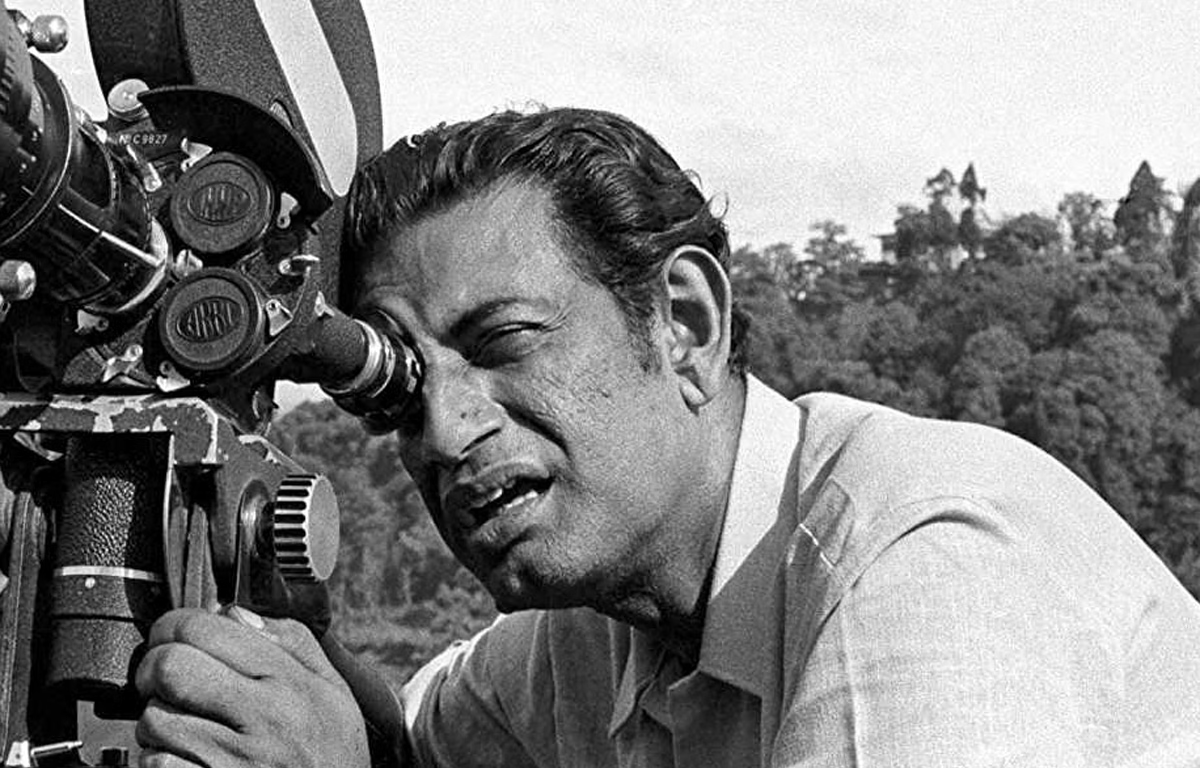
The film was Joy Baba Felunath, and that was my introduction to Feluda. It took a few more years for me to find the magician behind that film.
On rain-soaked days, wrapped in a blanket and lost in adventures with Feluda, and eventually Professor Shanku, whose diary format made every story feel like a secret I had stumbled upon- I slowly began to discover Satyajit Ray.
Those books made up most of my childhood.
As I grew older, my tastes shifted.
I discovered Bibhutibhushan Bandyopadhyay, fell in love with his writing, and read everything I could find.
Eventually, Pather Panchali came into my hands- for a teenager, a hard read, and yet I loved it! Knowing Ray was one of the greatest filmmakers of all time, I tried to watch the film.
I say “tried” because I failed. The film was even harder than the book for me.
Thus, a teenager who understood very little about cinema simply was not ready for it. But in my late teens, something shifted. I finally sat with the Apu Trilogy and let it wash over me.
That struggle, and that eventual surrender, is how I truly found Ray as a filmmaker.
Sonar Kella, Goopy Gyne Bagha Byne, Hirak Rajar Deshe — films I had watched as a teenager that felt simple at the time.
I know better now. Perhaps that is the thing about Ray, his films do not age, but you do, and suddenly you see what was always there.
Goopy Gyne Bagha Byne shows how easily war is manufactured by those operating behind power, while ordinary people have no real quarrel with each other, watching Donald Trump authorize military action while defense industries profit, the film stops feeling like fantasy.
Hirak Rajar Deshe hit even closer to home. We were afraid to write a single word of criticism during the Hasina regime; there were cases where people went to jail for a Facebook post. And yet, like in the film, the control was never total. The July revolution proved that. Ray resolved it with rhyme and rebellion. We resolved it with people who simply decided they were no longer afraid.
Now, as adulthood sets in, Ray’s characters feel less like strangers and more like previews. As graduation approaches, I suspect Dhaka will become my Adversary- searching and uncertain like the protagonist of Pratidwandi, or one day cornered by compromise like Shyamalendu in Seemabaddha.
And if I ever find myself face to face with a choice I am too afraid to make, standing right in front of what I want and still doing nothing , I suspect I will understand Amitabha in Kapurush in a way I hope I never have to.
And then there is Agantuk. Maybe someday I will become a little like the long-lost uncle.
Tired of pretending. Quietly stepping outside of everything the world expects. Choosing curiosity over belonging. I hope I have that courage.
Satyajit Ray has run through my life like a quiet thread. I know he will keep coming back, in different layers, at different ages. And I will keep finding new reasons to connect with his work.
Today is his birthday. On this day, I have only one thing to say: Maharaja, tomare salam!